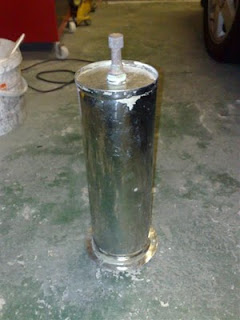
I was having a sandwich lunch down at Tyrella beach on the Co Down coast back in late September and went for a walk afterwards and found this thing half-buried in the sand. It turned out to be a boat immersion heater of some sort (I don't own a boat so maybe someone can enlighten me). There was an electrical element and 2 pipes coming out of the top and the bottom connection you can see in the photo. It must have been thrown overboard (assuming the boat it was on didn't sink!), maybe after being replaced. It had been in the sea a while by the looks of it, but being stainless steel it has started to polish up quite nicely. The lid is held on by 6 bolts and I gutted all the old gubbins out of it to get the cylinder itself. Willis Solasyphon Anyway, the basic plan is to wind 1 or 2 tight coils of 8mm microbore copper pipe like in the photo above and make a heat exchanger out of the cylinder. I've had a go at winding this type of coil before and it isn't easy, but I'd ...
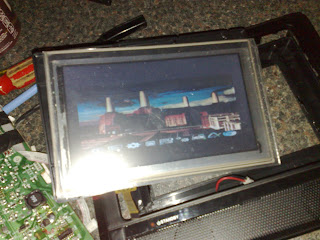
I got around to taking the screen out of one of the LCD units to see what could be done with it. For a start the actual screen is 6.2" (according to the serial number and a ruler) not 7" as on the manufacturer's website, but that's no bad thing. It turns out a 6.2" screen is just the right size to fit in a double-DIN car radio slot, which prompts all sorts of ideas. It also turned out that there were 2 circuit boards, a big one with an audio amplifier and some power supply circuitry and a small one for the actual screen. Essentially the screen will operate with just a 4-wire connection (9 volt, GND, Video and Video GND). There is another connector for options (screen mode, colour and brightness), but with nothing connected to this the monitor defaults to perfectly use-able settings. In the photo I have it hooked to a PC via a VGA-to-Video adaptor. The computer is running Tiny Core Linux (my new favourite distro) in 640 x 480 mode (I think). It will go down to 320...
This is tantalising... I found some data on driver chips used on these low-cost monitors and some of them have an I2C connection for sending pixel data directly to the screen. This may be to allow text or graphics overlay. Anyway the chip on my 7" screens is an AR05C-LF and there are millions of these in stock in the far east, but I can't so far find a data sheet for this chip or its sibling the AR05CA-LF. Being able to send digital pixel data via I2C directly to the screen would be, well, brilliant.
Comments
Post a Comment