Posts

Showing posts with the label led

Tiki Bar Lighting Upgrade

Image
I have a couple of 20 LED solar strings in the tiki bar at the back of the house. After a couple of years outside the strings weren't working so well and opening up one of the solar panel units I found the AAA NiCd cell inside was only holding 0.5 volts instead of 1.2 volts when fully charged. Initially I went to a few shops looking for direct replacement strings but couldn't find any. Then in Home Bargains I found 50 mini LED strings with larger solar panels and a lithium-ion battery for only £3. So I bought 2 of these and chopped off the LED strings as I was only interested in the solar panel units. An initial test with just twist-and-tape wiring proved this upgrade would work. The next step was to take the solar panel units apart and solder the wiring for my LED strings in properly. I decided to mount the solar panel units under the composite roof to keep them dry so that hopefully they will last a few years longer than the ori...

Case in Point

Image
So a few years ago I got a broken one of these. I stripped it out for parts and the other day finally got round to cutting a new front and back for it. Now I just need a retro project to put in it, but the internet clock is the top contender.

Another TV Repaired!

Image
This Freegle donation is a 32-inch JVC Smart television with LED backlight. The set was powering up, but no picture, so the backlight was suspect. The very bright torch trick revealed a picture lurking in the murk, so the set was worth repairing. The power supply was putting out 94-volts to the backlight which seemed excessive, but before I could investigate further I managed to short something and the output dropped to just 30-volts. I decided to take a chance on a replacement power board off eBay and while that was on its way I dismantled the television to take a look at the LEDs. The diode test setting on my DMM (digital multi-meter) was reading open-circuit, but across a lot of LEDs this doesn't always mean anything. Carefully taking the thing apart and putting the LCD panel to one side, I discovered that there were 22 LEDs, but one had already been removed and soldered over so someone had previously tried repairing the set. The problem with this shorting-out approach is...

LED DIY Replacement Lamps

Image
I was given 4 interesting decimal digit displays some years ago which had been part of airfield equipment which was being upgraded. These use 10 tiny 28-volt bulbs for each digit, each illuminating a clear plastic slide etched with the numbers 0-9, a precursor to the 7-segment display. I wanted to upgrade the displays to LED illumination with the possibility of building a retro clock of some sort. The bulbs are a miniature T1-3/4 size which are 5mm, but have a wider flange so a 5mm white LED wouldn't be a direct replacement. 12-volt LEDs are available in the T1-3/4 size, but at about £3 each this would cost me £120 to replace all 40 so that was a nonstarter. After some thought, I hit on this alternative. M5 washers with a 10mm outer diameter, solder the anode to the washer and bend the cathode roughly into the middle. Cheap and works!

LED Backlight Repair

Image
A kind lady on Freegle gave me a load of broken electronic items including a 39-inch  ISIS brand LCD television. It turned out this was another Vestel rebranded chassis. I rigged it up to a DVD player and used the bright torch trick to check that there was an active picture, but no backlight. There was about 120 volts being delivered to the backlight and a bit of research online suggested at least 1 of the LEDs might have gone open-circuit. I dismantled the entire set as carefully as possible and found 5 strips of 9 LEDs, all 45 wired in series. This requires a voltage of about 135 volts, but means the current can be kept low and constant. With the strips separated I was able to apply about 25 volts to each strip. 2 strips were fine, 2 were illuminating, but had a dead LED each (LEDs had shorted out) and the last was completely dead meaning an open-circuit LED. On the bench I was able to identify the open-circuit LED. I had some salvaged LED strips from a television that had suffer...

Television LED Light Box

Image
Another broken television, this time a slimline 32-inch Bush which had suffered a cracked LCD during a house move. So I took off the LCD panel and dumped that and behind we have 22 high-output LEDs as a backlight. These are 3-volts each and wired in series so that the current can be kept constant and relatively low, which means the power supply has a 66-volt feed out to the backlight. Luckily the power supply is working fine so it was easy to rig a test (always being careful not to electrocute oneself, kids) and even control the light using the power button on the old remote. It is very bright and looks amazing. The only downside is where to put the power supply so that it is out of harm's way and earthed because the remnant case is metal. Unfortunately it is just too wide to sit in between the 2 rows of LEDs inside the box, but I'll work on it.

LCD Monitor LED Backlight Conversion Update

I think I have finally managed to convert an LCD monitor with a faulty backlight to LED backlighting. As is very common the cold cathode lamps or the inverter had failed so i nstead of a clear white light I was getting a purple sort of hue and not a very bright one at that. This is a tricky enough job and the first 2 I tried, an old TV and a monitor,  didn't survive the surgery, but this one seems to have. I need to finish the wiring, but early tests show a good image. UPDATE - 1st April 2014 The inverter had failed and there was a tell-tale burn mark round one of the transformers on the PCB. I got the LEDs wired to a 14v feed from the power board in the monitor. A good hack I think, but a brightness control will need to be sorted out using a cheap PWM power control module.

Edge-lit Display Decoder Test

Image
The display is being illuminated using 10 white LEDs salvaged from a £1 string of battery-powered Christmas lights.  This is a very cheap way to get white LEDs with flat tops and I found 30 more LEDs on strings like this so that's enough for 3 more digits. The decoder takes a 4-bit binary-coded decimal (BCD) value and uses a 74HC138 to decode 0-7 and a 74HC00 to decode the remaining 8 and 9 digits (values above 9 are meaningless in this set-up).  To test the circuit I connected a rotary BCD-encoded switch I've had in the spares box for almost 20 years.  The switch goes from 0-15 (decimal) coded in 4-bits and the flickers to 0 you can see in the video are caused by the switch breaking before make. This is the hard work done.  Using 2 more HC chips and a ULN2803 I can build a simple 2-4 line decoder with increased current handling. This will allow a PIC or Arduino to multiplex drive 4 displays using just 6 output lines. I might even use an old 16F84 I have as an I2...

Interesting Display

Image
This is just a taster. This is an interesting edge-lit numeric display from the 1960s, a successor to the Nixie tubes. The arrival of 7-segment displays in the late 60s probably made these ones obsolete so they are quite rare. Each digit 0-9 is inscribed on a thin piece of transparent acrylic and these are sandwiched together. Each digit can be illuminated by its own 28-volt bulb. Nowadays bright white LEDs are the alternative to small bulbs so here we have the digit '8' being lit up by an LED driven from 5 volts. More to follow.

LED Backlight

http://www.flickr.com/photos/44653173@N00/sets/72157633242265497 This is just a first attempt at upgrading a monitor to LED backlighting.  The power supply for this monitor seems to be busted after all, it isn't working once it is under load.  I'll test it with a PC power supply later. Unfortunately I managed to break one little connector when I was taking the monitor apart, but this may be repairable, I'll have to see. The light output from the LEDs is fairly even and the only downside for now is no brightness control, but that should be possible to address if need be.

String of LEDs

Image
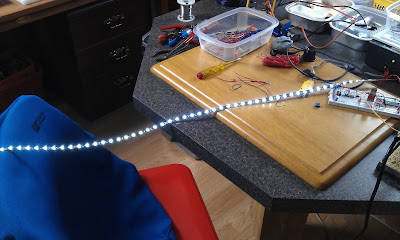
These are hopefully going to replace the cold cathode backlights in the second Hanns-G monitor I picked up, which has a failed inverter board. This is a 1 metre strip containing 60 LEDs and running off 12v and cost £5 delivered. The strips can be cut every 3 LEDs and there are copper pads for soldering to. If this works I'm going to convert the other Hanns-G monitor, the 21 inch TV I rescued from a ditch and the 7-inch LCD monitors to LED backlights. Buying longer runs of LEDs, the cost gets cheaper so 5 metres with 300 LEDs is only £15, enough for lots of backlights.